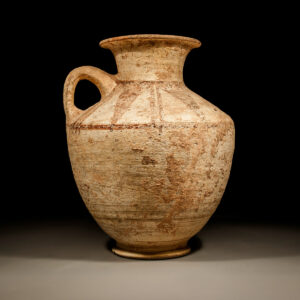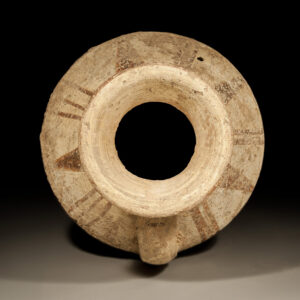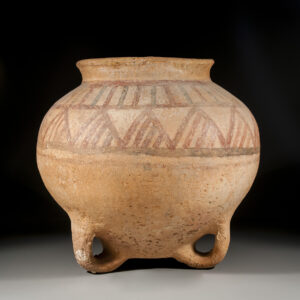
Canaanite Loop Footed Painted Jar
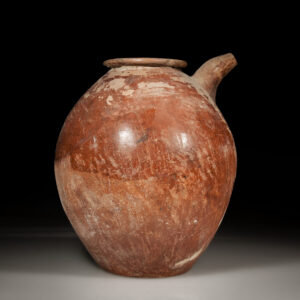
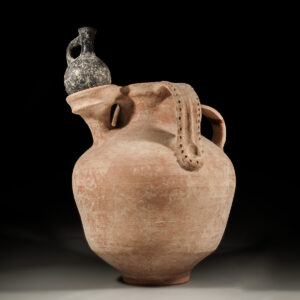
A Canaanite loop footed painted jar
REFERENCE #
KB_PT_0060
CIVILIZATION
Middle Bronze Age, 1700 B.C.E. – 1600 B.C.E.
SIZE
H. 26.5 cm
CONDITION
Fine condition
PRICE
Price available upon request

Showing 17–32 of 72 results
A Canaanite loop footed painted jar
KB_PT_0060
Middle Bronze Age, 1700 B.C.E. – 1600 B.C.E.
H. 26.5 cm
Fine condition
Price available upon request
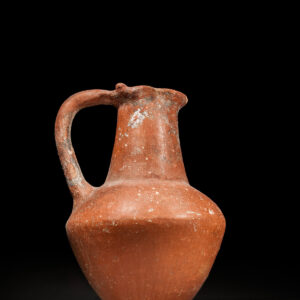
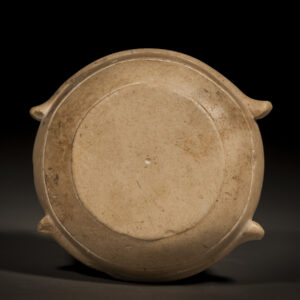
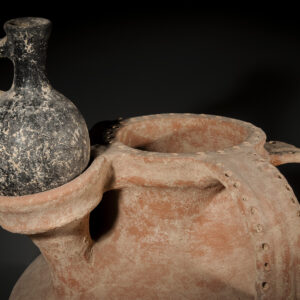
The natural polish of this red slip spouted jar shines brightly even under the softest of lights. The large ovoid body of this piece has no neck, but instead a flattened ring atop its mouth and a bent spout with a small hole for measured pouring. This suggests an efficiency commonly found throughout the arid regions of ancient Canaan, when water and wine were too important for the casual spill.
KB_PT_0597
Early Bronze Age, 3500 B.C.E. – 3000 B.C.E.
H. 23 cm
Fine condition
Price available upon request
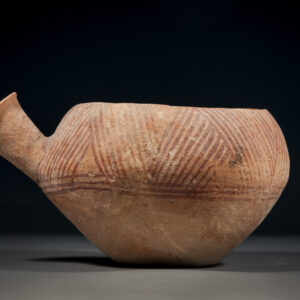
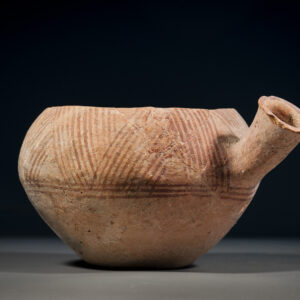
Wide Canaanite terra-cotta bowl with a single large spout protruding at a 45-degree angle from halfway up the body. The body tapers to a flattened base while the large mouth lacks embellishment. Monochrome paint marks the body’s upper half in parallel lines that intersect in diagonal planes.
KB_PT_2901
Early Bronze Age, 3500 B.C.E. – 3000 B.C.E.
L. 18 cm
Repaired
Price available upon request
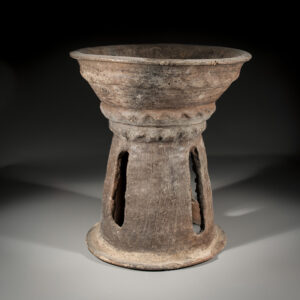
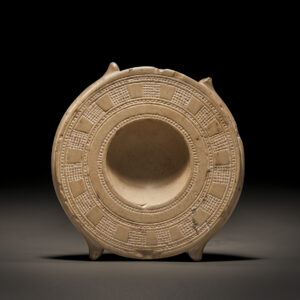
A ceramic fenestrated ceremonial stand
KB_PT_0040
Chalcolithic Period, 4000 B.C.E. – 3500 B.C.E.
H. 27 cm
Fine condition
Price available upon request
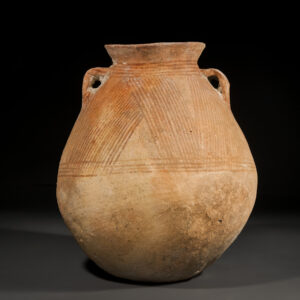
The thin lines that mark the top half of this large amphoriskos are on the primal end of art history, yet their application is so intricate as to reveal the care and attention to detail of the Canaanite artisan who applied them to the vessel’s exterior over 5000 years ago.
The large egg-shaped body of this amphoriskos allowed it to hold substantial amounts of liquid, be it wine, water or oil. The rich desert tones of its smooth exterior stand out boldly among the monochrome paint that scratch its surface.
KB_PT_2510
Early Bronze Age, 3500 B.C.E. – 3000 B.C.E.
H. 20 cm
Fine condition
Price available upon request
A classic Canaanite Levantine periform painted ware juglet[/vc_column_text]
KB_PT_0053
Middle Bronze Age II A, 1800 B.C.E. – 1700 B.C.E.
H. 13.5 cm
Excellent condition
Price available upon request
A classic Phoenician trefoil lip jug
KB_PT_0104
Iron Age II, 950 B.C.E. – 850 B.C.E.
SIZE
H. 29 cm
Fine condition
Price available upon request
‘Book of the Dead’ is a modern term for a collection of magical spells that the Egyptians used to help them get into the afterlife. They imagined the afterlife as a kind of journey you had to make to get to paradise – but it was quite a hazardous journey so you’d need magical help along the way.
Prior to the New Kingdom, The Book of the Dead was only available to the royalty and the elite. The popularity of the Osiris Myth in the period of the New Kingdom made people believe the spells were indispensible because Osiris featured so prominently in the soul’s judgment in the afterlife. As more and more people desired their own Book of the Dead, scribes obliged them and the book became just another commodity produced for sale.
From the New Kingdom through the Ptolemaic Dynasty (323 – 30 BCE) The Book of the Dead was produced this way. It continued to vary in form and size until c. 650 BCE when it was fixed at 190 uniform spells but, still, people could add or subtract what they wanted to from the text. A Book of the Dead from the Ptolemaic Dynasty which belonged to a woman named Tentruty had the text of The Lamentations of Isis and Nephthys attached to it which was never included as part of the Book of the Dead. Other copies of the book continued to be produced with more or less spells depending on what the buyer could afford. The one spell which every copy seems to have had, however, was Spell 125.
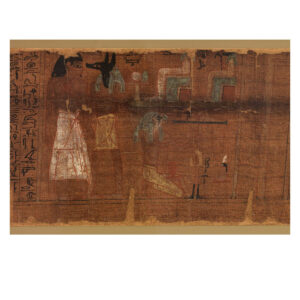
Featured here are two papyrus fragments from the Egyptian New Kingdom, 18th Dynasty (circa 1400 BCE) of an Egyptian Book of the Dead written for the Royal sandal-bearer of Isis, Min-Her-Khetiu:
The smaller papyrus sheet includes the painted figures of a woman and the dead man, their hands raised in adoration. Between them a column of hieroglyphs gives the name and title of the owner. Seven columns of hieroglyphs in the center contain the opening of Chapter 7 headed ‘Chapter of Sailing in the Bark of Ra’. Above this an accompanying vignette of a shallow boat containing the falcon headed Ra crowned with solar disc and flanked by wedjat eyes to signify health and security. To the right four columns recounting part of Chapter 149,’The Fourteen Mounds’, the illustration above showing a pottery jar with liquid spilling from it.
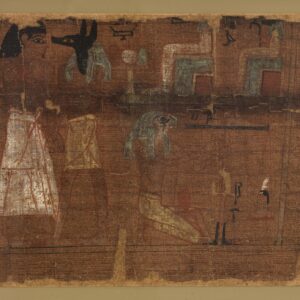
The longer sheet carries thirty columns of Chapter 125 ‘The Declaration of Innocence’ with a scene showing standing figures of Anubis with the dead man to the left of a kneeling falcon headed god (Horus though he is labelled Thoth) supervising the weighing of the heart against Maat. Two seated gods above the scales represent the 42 gods who witness the judgement. Two of the three columns in the center are from Chapter 81a ‘Spell for becoming a lotus’ and on the right side of the sheet are ten columns from the beginning of Chapter 144 ‘Address to the Keepers of the Underworld’ with the paired figures of the horned guardian and reporter of each gate shown at the foot of the column.
Other fragments from the same scroll can be found in the Cairo Museum and the Papyrus Museum, Syracuse, Italy. This piece is the oldest illuminated manuscript of the Egyptian Book of the Dead in private hands, and among the oldest literary manuscripts (MSS) on papyrus.
Previously Maurice Nahman, Cairo, acquired 1930s; The Schøyen Collection, Norway.
Kon-Tiki Museet, Oslo, 2002-3
Barbara Lüscher, ‘Der Totenbuch- Papyrus des Minherchetiu‘ in Studien zur Altägyptishen Kultur, Band 36, 2006.
#SC_EG_1001
New Kingdom. 18th Dynasty, c.1400 B.C.E.
H. 14 x L. 33.2 cm and H. 15.5 x L. 88.8 cm
Fine condition
Available Upon Request
Maurice Nahman, Cairo, acquired 1930s; The Schøyen Collection, Norway. Exhibited: Kon-Tiki Museet, Oslo, 2002-3 Literature: Published: Barbara Lüscher, ‘Der Totenbuch- Papyrus des Minherchetiu’ in Studien zur Altägyptishen Kultur, Band 36, 2006.
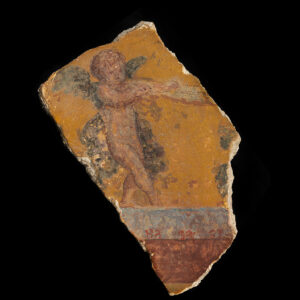
A fragment from a frieze depicting Eros as a winged child pulling on one end of a swag or garland. He is depicted naked apart from a cloak that hangs from his shoulders and behind his body, visible flapping loosely on either side of his legs. The fluttering ends of a cloak belonging to a second figure, presumably another Eros or possibly a Psyche, can be seen on the right. Painted on an ochre background with remains of two bands below of sky blue and terracotta. The edge of a lower register visible.
SI_RM_1094
Roman, 100 C.E.
H. 27.5 cm x W. 15 cm
Fine condition
Price upon request
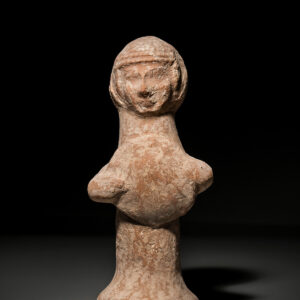
A Israelite figurine of Astarte holding a drum or bread?. The head on this figure was made in mould wearing a wig like headdress, the neck was then inserted into the pillar-shaped body. The pillar-shaped body is holding drum or bread. There is no doubt that the figurines were considered to have some magical properties and were kept in the household as amulets to enhance fertility.[/vc_column_text]
KB_PT_2799
Iron Age II, 800 B.C.E. – 600 B.C.E.
H. 15 cm
Fine condition
$4500
The Private Collection of K. Baidun. 1970’s
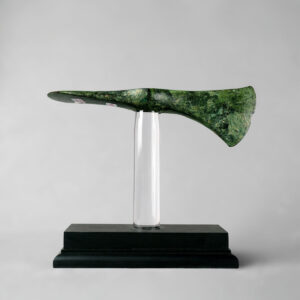
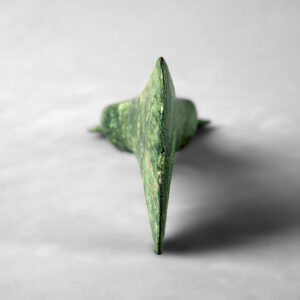
A cast bronze axe head with a cylindrical socketing shaft, a tapered spike on the back end, and a horizontal axe blade on the front.
For similar see: Nikolaus Boroffka, Simple technology. Casting moulds for axe-heads. In: Tobias L. Kienlin, Ben Roberts (ed.), Metals and society. Studies in honour of Barbara S. Ottaway.
Universitätsforschungen zur Prähistorischen Archäologie 169. Vertag
Dr. Rudolf Habelt GmbH (Bonn 2009), pp. 246-257, n. 1-2.
REFERENCE #
WP_PR_1115
Canaanite, 1200 B.C.E. – 800 B.C.E.
Time of the Israelite Kingdom
L. 20 cm
Fine condition
$2500
SI-IL-1027
Iron Age , 1200 B.C.E. – 800 B.C.E.
H. 11.5 cm
Fine condition
$7998
Jerusalem Private Collection 1950s
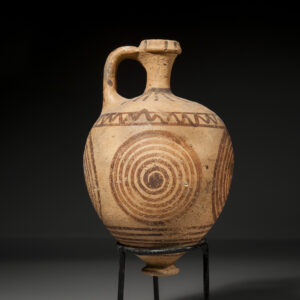
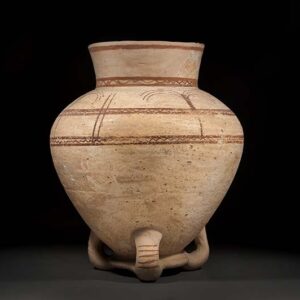
Large Canaanite chocolate and white ware, ancient Canaanite pottery corresponding to the Late Bronze Age of approximately 1530 B.C.E. – 1480 B.C.E.. Narrow base rises to wide smooth shoulders, topped by slightly flared neck with straight-rimmed mouth. Monochrome paint patterns in four distinct rings on vase’s top half, interspersed with four stylized palm trees. Base structure of three loops, each painted with four short straight lines, serves as tripod stand.
KB_PT_9984
Late Bronze Age IA, 1530 B.C.E. – 1480 B.C.E.
H. 26 cm
Fine condition
Price available upon request
A large Canaanite chocolate and white ware jug
KB_PT_9984
Late Bronze Age IA, 1530 B.C.E. – 1480 B.C.E.
H. 26 cm
Fine condition
Price available upon request